
-
TrendsArtificial IntelligenceReputationRisks
-
CountriesGlobal
We present a new predictive model that redefines how brands can anticipate and manage the ideological impact of their strategies in an increasingly polarized world.
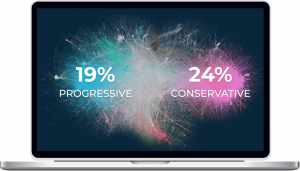
The model, which integrates Artificial Intelligence, community analysis techniques, and natural language processing, has analyzed nearly 250 real campaigns across four different sectors and delved into more than 860,000 social media messages with the goal of mapping an ideological perception trend of a brand for a specific market..
This new model adds to other innovative developments, such as IA Legislab, Proyecto GEA, AI People Insights or The Purple Check, we have participated as expert collaborators in AI and data science, such as ODESIA, with UNED, or The performance of artificial intelligence in the use of Indigenous American languages together with Microsoft and the IDB Lab.
The context: an environment of increasing polarization
We live in a world where social polarization is an undeniable reality. In Ibero-America, for example, the level of polarization in social conversation has grown by 39% in recent years. This dynamic not only divides communities around a communication territory, but when reflected in channels such as social media, we observe a high level of hostility in many of the most polarized communication territories.
Consumers have long demanded that brands take clear stances on certain issues, urging companies to adopt a public position on high-impact social controversies.
However, for many brands, taking a stand in a polarized territory can feel like stepping into a minefield. A rushed response, lack of strategy, or an ambiguous stance can worsen a crisis. Still, a brand can also be strengthened in these situations, just like Disney during the ‘Don’t Say Gay’ law episode in 2022 or Walmart after the Parkland shooting in 2018.
Our predictive model: AI at the service of reputation
To meet this pressing need, the Innovation team at LLYC has developed a predictive model that integrates Artificial Intelligence, data science techniques, and natural language processing to offer brands a clear roadmap in these situations. This model is complemented by other services we have been developing, such as our AI Synthetic Audiences, which allow our clients to test their communication strategies to ensure their reputation in an increasingly polarized world.
How do we achieve this?
We have analyzed nearly 250 advertising campaigns and videos, as well as more than 860,000 social media messages in four different sectors (Food & Beverage, Entertainment, Retail, and Automotive). This study initially focused on the U.S. market, an ideal scenario for research due to its size, political trajectory, degree of polarization, and the presence of leading brands.
Our methodology is based on:
- Large Language Models (LLMs) based on GPT-4o: to infer and score features and content of videos and animations, and to justify scores.
- Community analysis: based on social interactions and graph metrics.
- Natural Language Processing (NLP): including lemmatization, stemming, and bag of words.
- Creation of a predictive model: to evaluate three key risk factors: subject danger, risk of action, and risk of inaction.
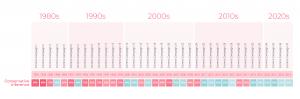
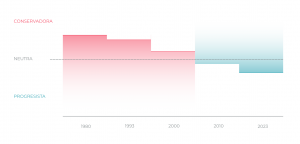
The model enables us to build a historical trend of how a brand is perceived ideologically in a given market, analyzing its ad campaigns from the 1980s to now. This lets us identify patterns, such as brands’ long-term trend to adapt to progressive trends, even for the most conservative brands.
IDEOLOGICAL PERCEPTION
KEY INDICATORS
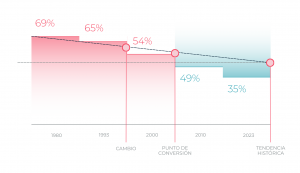
The predictive model analyzes two key variables to estimate the risks associated with taking a stance in a polarized territory:
- Topic: Metrics such as polarization, hostility, and conversation size are evaluated, determining the environment of a discussion territory.
- Brand: The model considers the brand’s current presence in the territory, societal demands, conservatism and intensity of the proposed action, and the brand’s history of ideological alignment.
The model in action
We have tested our model with real cases of companies in four different sectors that, one way or another, found themselves in the headlines and immersed in highly polarized conversations.
BRAND 1 AND BRAND 2 GRAPHIC
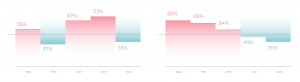
The results have been very revealing and have allowed us to get the model ready to be tested with any brand and context in the 13 countries in which we operate.
As part of the process, several key conclusions have emerged for managing reputation in polarized environments:
- The more a topic is discussed and the more polarized and hostile it becomes, the riskier it is to take a stance.
- The more a brand is called to act and the less it responds, the riskier it becomes to remain silent.
- The more a campaign contradicts the brand’s historical positioning and the greater the campaign intensity, the riskier it becomes.
- Ideological inconsistency and ambiguity increase the risk of action by 60% above average.
- Being deeply involved and required in a specific field creates a strong need to remain active, doubling the risk of inaction compared to the average.
- In most cases where brands have taken risky actions, they have been driven by a desire for anticipation rather than by the potential dangers of remaining passive.