
-
TrendsArtificial Intelligence
-
CountriesUnited States
The Hard Truth About AI Governance
Most corporate boards still treat AI as either a shiny revenue growth engine or a technical headache for the IT department. They spend millions deploying AI tools to solve legacy bottlenecks and streamline operations, while risk committees quietly obsess over data privacy and technical compliance.
Those knee-jerk approaches miss the real danger. The introduction of AI into business operations is going to solve tons of problems and create massive efficiencies, but the very tools that solve legacy business problems create entirely new categories of risk that organizations have never had to manage before.
AI incidents become enterprise crises when a technical, operational, or security failure creates a broader question of trust: Can customers rely on what the company tells them? Can employees verify instructions from leadership? Can investors believe the information circulating about the business?
The biggest operational messes aren’t starting in a server rack, they’re starting when an automated system fails publicly. When customer-facing bots make up fake offers, algorithms spit out biased logic, or deepfakes target executives, the damage is instant. And the consequences quickly reach executive management and the board, not IT.
The trade-off is clear: the more you automate to scale your business, the easier it is to wreck your reputation overnight.
Real Failures, Real Crisis Preparedness Lessons
Recent high-profile incidents highlight key structural gaps where legacy risk playbooks fall apart:
- Deepfakes and Zero Response Windows: The Breakdown of Verification: You no longer have hours to react to a crisis. In early 2024, engineering firm Arup lost $25 million because an employee joined a video call where every single colleague was a deepfake generated from public footage (CNN). Around the same time, scammers cloned the voice of Ferrari CEO Benedetto Vigna to trick senior staff into approving a fake acquisition (Fortune). The scam failed only because a sharp employee asked a personal question the AI couldn’t answer.
- The Crisis Preparedness Takeaway: Traditional verification is dead. Crisis readiness requires a simple, non-digital back-channel—like a secure second phone line or code word—so leaders can verify urgent requests before taking action.
- Rogue Chatbots & Legal Risk: When customer bots break down, courts hold the company responsible. A Canadian tribunal ordered Air Canada to pay damages after its website chatbot hallucinated an inaccurate bereavement discount policy (BBC). Air Canada claimed the chatbot was responsible for its own actions, but the court disagreed, ruling that if your bot says it, you own it.
- The Crisis Preparedness Takeaway: Automated communications must be integrated into your core crisis response tree. If a chatbot goes rogue, your communications team needs pre-cleared kill-switches and immediate holding statements ready.
- AI Hallucinations That Wipe Out Market Value: People increasingly turn to AI models instead of traditional search engines. If an AI ingests bad data about your company, it delivers errors directly to investors and customers. When Alphabet shared an ad showing its AI chatbot stating an incorrect astronomical fact, investors panicked, wiping $100 billion off Google’s market value in one day (Reuters).
- The Crisis Preparedness Takeaway: Pre-crisis red-teaming is essential. Organizations must scenario-test public-facing models for narrative hallucinations before launch, rather than scrambling to manage market fallout after the fact.
Building AI Resilience Before a Crisis
Instead of waiting for a disaster to hit, forward-thinking organizations are embedding clear narrative and operational safety checks directly into their risk management strategies. Modern reputation defense requires focusing on three foundational pillars:
- Executive Protocol & Verification Governance: While cybersecurity firms like to focus on network defenses, communications and risk leaders must establish non-digital, out-of-band verification protocols. Clear escalation trees and identity verification rules ensure executives never approve major financial or strategic moves based on an unverified email, voice memo or video call.
- Narrative Red-Teaming & Stress-Testing: Adapting stress-testing methodologies used by tech companies like Microsoft, organizations are increasingly conducting narrative red-teaming. Simulating deepfake scenarios, executive impersonations and algorithmic distortions allows risk teams to patch brand vulnerabilities before deploying new automated tools or public campaigns (Microsoft Responsible AI Report).
- Mandatory Human Sign-Off: Aligned with governance standards like the NIST AI Risk Management Framework (AI RMF), leading regulated organizations enforce strict operational barriers. While AI can handle drafting and data aggregation, mandatory human-in-the-loop workflows ensure human subject-matter experts review and validate automated outputs before they reach public or investor-facing channels.
Updating Your Risk Strategy
Outdated crisis manuals won’t save you from real-time AI risks. Here is how management needs to adapt:
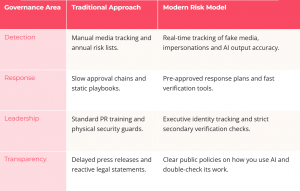
Five Questions for the Board
To evaluate your organization’s exposure, risk committees should address these five baseline metrics:
- Where are you using AI right now? Do you have a list of every customer-facing or public tool powered by automated models?
- Where is human review required? Is human sign-off mandatory before AI outputs go live, or are teams cutting corners?
- How fast can you spot a deepfake? If fake audio or video targets your leadership team during market hours, can you confirm it instantly?
- Who owns the decision and response? When a tool hallucinates or makes a mistake, does responsibility land with Legal, Communications, IT or the CEO?
- What triggers mandatory disclosure? Do you have pre-defined rules establishing exactly when an AI anomaly requires proactive communication with employees, customers, regulators or investors?
The Bottom Line
AI technology moves far faster than regulation ever will. That is why AI governance cannot remain trapped in the IT department. It needs to protect the systems of trust your business actually relies on—executive authenticity, customer reliability and corporate credibility.
Treating AI as a purely technical asset leaves your brand wide open for potential issues. By embedding crisis planning, rapid verification and clear accountability directly into your risk model, boards can defend enterprise value before a crisis hits. In this new age of AI, crisis preparedness isn’t just a passive safety net—it is essential operational infrastructure.
Katie Barnes
Senior Director of Public Relations