-
TrendsArtificial IntelligenceEconomyTalent
-
CountriesSpain
The role of the chief executive has ceased to be exclusively a management space to become a continuous exercise of judgment, resilience, and proactivity. In an environment conditioned by short-term volatility, public scrutiny, and the emergence of AI, leading a large organization today demands qualities that go beyond experience or traditional hierarchy.
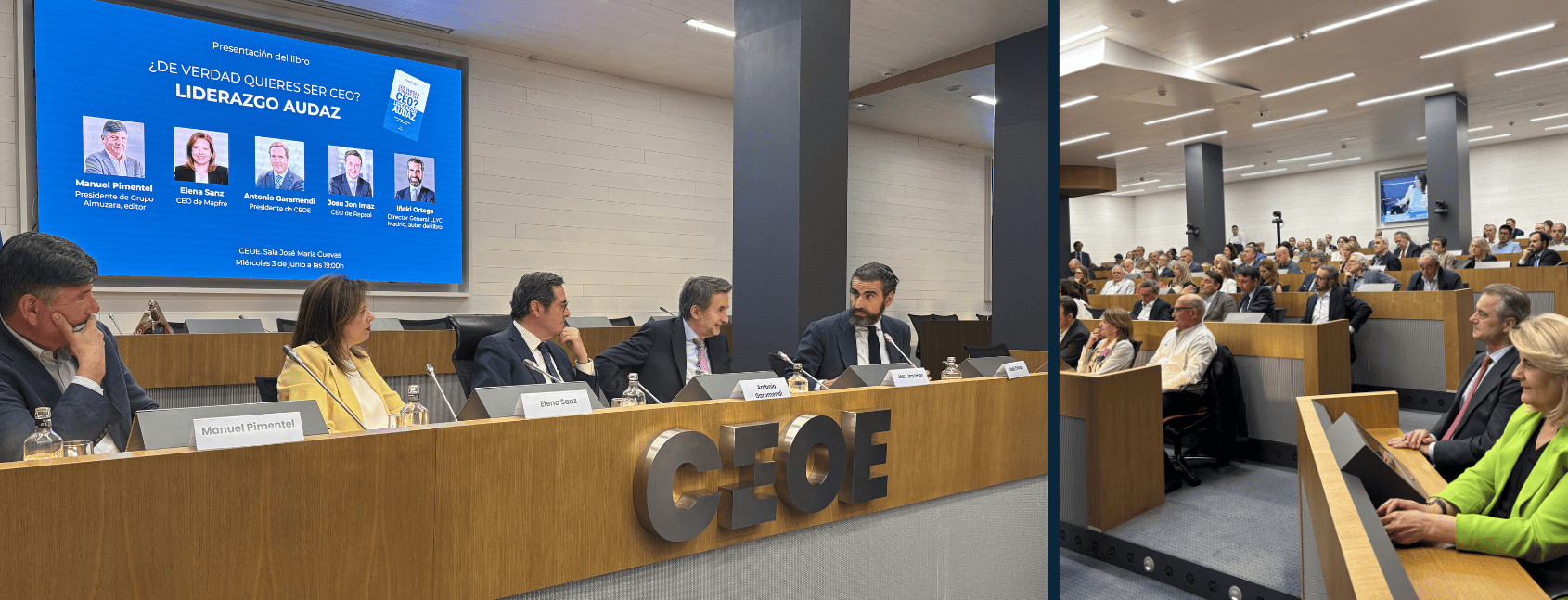
Under this conceptual framework, the latest book by Iñaki Ortega, Managing Director of Madrid: ¿De verdad quieres ser CEO? Liderazgo audaz. (Do you really want to be a CEO? Bold leadership), was presented at CEOE. The meeting, which filled its capacity with more than 250 executives and institutional representatives, counted on the support of our executives Jorge López Zafra and Luisa García, and served to analyze the current demands of the C-suite.
The author shared the table and debate with Josu Jon Imaz (CEO of Repsol), Elena Sanz (CEO of Mapfre Iberia), Antonio Garamendi (president of the CEOE), and Manuel Pimentel (publisher and president of Grupo Almuzara). Three major vectors that are redefining corporate governance emerged from the conversation:
1. The loneliness of the final decision
Faced with the trend of infinite deliberation, contemporary leadership requires assuming responsibility at the critical moment. Josu Jon Imaz resorted to the metaphor of “the loneliness of the penalty kick” to illustrate decision-making in companies’ moments of truth: although the consultation processes are collective, there is a moment when the chief executive must decide individually.
Imaz exemplified this commitment by recalling Repsol’s decision to keep its essential services open during the pandemic, prioritizing social impact and the future of the company over the immediate result of that fiscal year. The ability to combine short-term viability with the sustainability of the future horizon defines the maturity of an organization today.
2. The obligation to exercise power against immobility
The true risk for a corporation in times of transformation is not error, but paralysis. Elena Sanz stressed that immobility is a leader’s greatest irresponsibility, pointing out that once the trust of shareholders and society is accepted, the obligation to act is assumed.
Elena Sanz shared the challenge that transforming an organizational structure consolidated over 25 years meant for Mapfre Iberia to gain agility and closeness to the customer. In sectors where the main asset is intangible, such as trust, operational boldness is an indispensable condition to ensure market relevance.
3. The danger of isolation and the ethical challenge of AI
Another of the major challenges analyzed was the so-called “office effect,” that distance that can open up between steering committees and the reality of the environment. The panel’s unanimous response to this risk was active listening and the need to surround oneself with teams with divergent opinions that challenge the leader’s criteria.
This listening ecosystem also includes the adoption of new technologies. The debate addressed AI as a vector of efficiency and knowledge, but with the shared warning of not letting oneself be determined by it. Antonio Garamendi described AI as “the new total revolution,” a challenge that transcends the technological frontier to become an ethical and social debate that will force the reconfiguration of the relationship between companies, professionals, and the social contract itself.
Managing in the scenario of permanent exposure
Companies need strategic partners to govern in uncertainty and assume risks under high public exposure. It is at these critical turning points where brave decisions, backed by communication, creativity, and data-driven influence manage to shield the most valuable asset of any business project: the trust of its stakeholders.
In this context of transformation, bold leadership also requires mastering institutional relations and the regulatory environment. If you are interested in these matters, I encourage you to learn about the LLYC Public Affairs Program directed by Iñaki Ortega, which starts this June. It would be a true pleasure to have you in this 5th edition.